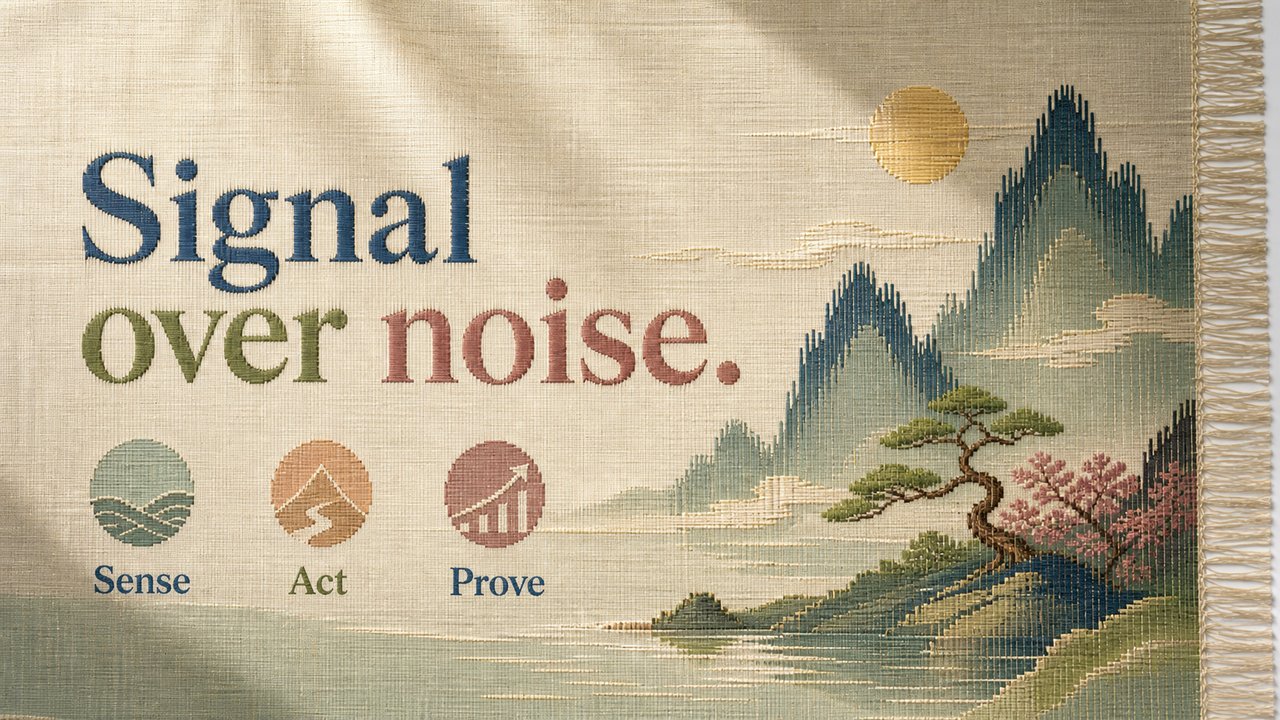
Kesi Silk Tapestry
Textilecut-weftdelicatesilkslit
Kesi cut-silk tapestry — delicate slit-weave, quiet and fine.
Swatch shows the same line — Signal over noise — rendered in this material, so the surface is the only variable.
Prompt formula
SURFACE:  Fine plain-weave silk tapestry made by the 通经断纬 method — the warp runs continuously but each colour weft turns back within its own area instead of crossing the full width. The signature must be unmistakable - SLITS (缂) — tiny open gaps and hairline seams along every vertical colour boundary, so the design looks carved out of the cloth ("雕镂之象"). Tonal shading is achieved by interlocking comb-tooth transitions (长短戗) between adjacent colours, never by blending or airbrush. The silk is thin, matte and slightly translucent with light glowing through the slits. No long floating threads anywhere. Palette - ivory and pale celadon ground with soft indigo, moss green, apricot, dusty rose and one restrained pale gold — refined and quiet, a scholar's object rather than a ceremonial one. Even soft light; the cloth held flat with delicate rippling; one edge shows loose warp fringe.
SKELETON: auto by page role (cover / chapter / list / compare)
DEVICE:   the page's argument drawn as a form native to this material
END:      Full-bleed 16:9 — render DEVICE on the SURFACE, per the page's composition.
CRITICAL: title = the page's TEXT in its own language, clean and legible; NEVER invent words or glyphs beyond TEXT;
annotations only as marks / numbers / dimension lines; no UI, no cards, no captions.
Source
Material recipe from the PPT-Zen 32-material library. Our own artwork.
License: CC-BY-4.0 · contributions via DCO